23 Nov 2015

Dissociating Terrorism From Islam: A Look at the Rise in Recent Terror Attacks.

Another day, another terror attack. This time at a Radisson Blu Hotel popular with Westerners in the Malian capital Bamako where a security conference was apparently taking place at the time. This follows a series of deadly attacks by the militant group 'Boko Haram' in northern Nigeria just a couple of days ago. And of course not forgetting the deadly attacks in Paris a week ago, and the downing of the Russian Airliner in Egypt last month.

All these attacks are claimed to be perpetrated by so-called Islamic militants who are nothing but a bunch of barbaric lunatics who have nothing, what so ever! to do with such a peaceful and noble religion. The name 'Islam' according to scholars is derived from the Arabic word 'Salam' which literally means peace. Therefore a devout and true Muslim is expected to be peaceful and shall hold no hatred or grudges against anyone. As a born Muslim, one of the first things I was taught as a child is killing of a fellow human being is forbidden in Islam and so is committing suicide. So if this people are blowing themselves up and killing innocent people in the name of Islam, certainly NOT IN MY NAME and not in the name of the Islam I practice.

Gunmen attacked a Radisson Blu Hotel in Bamako, Mali. Source: dailymail
A lot of sentimental expressions has been voiced in the wake of the of Paris attacks.  There is increasing resentment towards Muslim communities in most Western countries which is very unfortunate indeed. Good Muslims are God-fearing and peace-loving people who have nothing to do with such madness. Of course, people have the right to voice their opinions and concerns if their ways of life are threaten but trying to categorise all 1.6 billion people - over 23% of the world population as terrorists is a grave misconception, and will only create an environment where hostility will continue to thrive.

Thankfully, there is a high number of like-minded people out there who understand the true nature of Islam and will never associate it with terrorism. TERRORISM has no religion! How can anyone justify randomly spraying bullets on innocent people for simply relaxing on a beach, dining in a restaurant or watching a music concert? And how can anyone justify blowing up an aeroplane in the skies, or killing innocent people in a hotel or shopping mall? People going on about their daily activities only to have their lives senselessly ended. This is BARBARIC as much as it is COWARDLY! And this perpetrators hiding in the name of Islam (not my Islam) committing such atrocities must be STOPPED in any means necessary.

Suicide bomb attack at a Mosque in Yola city, Nigeria. Source:  channelstv
It's no hidden fact that some Western countries are part and parcel of all this problem. America and her Western allies invaded Iraq in 2003 for apparently having a nuclear missile which was later found to be untrue, and which resulted in the subsequent execution of Saddam Hussein in 2006. Through NATO, they again invaded Libya which resulted in the killing of Muammar Ghaddaffi in 2011 for no apparent reason. If this two men were still alive, am not sure we will see such a mess in the Middle East today.

The said period coincided with the so-called Arab spring which marks the beginning of the Syrian conflict. And ever since, the so-called Western powers have been watching Bashar Al-Assad butcher and maim his people while doing nothing rather than issuing mere political rhetoric. Or did they finally realised that ousting Saddam and Ghaddafi are the two fundamental reasons why we are all in this mess today? Or is it because Russia and Iran backs the Assad's regime? We shall see how their new G20 agreement to end the conflict pans out.

That being said, the problem today is not only a Western one, rather a problem for the whole world. To say that the situation is complex is an understatement, and world leaders are certainly overwhelmed. They are wary that air strikes alone won't achieve much desired results and there is no way they can enter into dialogue with such perpetrators. Therefore the fight should involve everyone - Muslims, Christians, Jews, Buddhist, Atheist or whatever your believe is. We should all stand and denounce terrorism in the strongest of terms and of course completely dissociate it from Islam.


16 Nov 2015

Valletta Summit on Migration: Is it right for the EC to set up a 'Trust Fund' for Africa?

African and European political leaders met at the Maltese capital Valletta from 11 to 12 November, 2015 to discuss the growing issues of migration between the two continents. As a result, the European Commission has set up an 'Emergency Trust Fund' of €1.8 billion for Africa and has urged member countries to follow suit. So will the so-called trust fund be the answer to the migration crisis or will it be a state of 'too little, too late'?

According to the UNHCR, about 820,000 refugees/migrants have arrived in Europe by sea so far in 2015, while about 3,500 have died trying to make the perilous journey. 85% of arrivals come from the world's top 10 refugee-producing countries with Syria producing a staggering 52%, followed by Afghanistan at 19%, Iraq 6% and Eritrea 5%. Nigeria, Pakistan and Somalia follows with 2% each while Sudan, Gambia and Mali complete the top 10 with 1% each. 

Given that 6 out the top 10 refugee-producing countries are in Africa, it make some sense for the EC to set up the 'Trust Fund'. But with these 6 countries producing a combined total of only 12%, far less than what Afghanistan alone produces, setting up such a fund becomes rather questionable. And how the fund is going to work in the long term also raises some eye-brows.

Family Photo, Source: European Commission
So to fully understand what the fund entails and how is it going to be operational, we reproduce the following report from the European Commission:

The European Commission has launched an “Emergency Trust Fund for stability and addressing root causes of irregular migration and displaced persons in Africa”, made up of €1.8 billion from the EU budget and European Development Fund, combined with contributions from EU Member States and other donors

WHAT IS A TRUST FUND? A Trust Fund is an innovative mechanism under the EU’s Financial Regulation used in the field of development cooperation to pool large resources from different donors to enable a swift, common, complementary and flexible response to the different dimensions of an emergency situation.

WHO BENEFITS FROM THE TRUST FUND? The Trust Fund will benefit a wide range of countries across Africa that encompass the major African migration routes to Europe. These countries are among the most fragile and those most affected by migration. They will draw the greatest benefit from EU financial assistance. The countries and regions are:

  •  The Sahel region and Lake Chad area: Burkina Faso, Cameroon, Chad, the Gambia, Mali, Mauritania, Niger, Nigeria and Senegal. 
  • The Horn of Africa: Djibouti, Eritrea, Ethiopia, Kenya, Somalia, South Sudan, Sudan, Tanzania and Uganda.
  • The North of Africa: Morocco, Algeria, Tunisia, Libya and Egypt.
  • Neighbouring countries of the eligible countries may benefit, on a case by case basis, from Trust Fund projects with a regional dimension in order to address regional migration flows and related cross- border challenges. 
WHAT IS THE AIM OF THE TRUST FUND? The Trust Fund aims to help foster stability in the regions and to contribute to better migration management. More specifically, it aims to address the root causes of destabilisation, forced displacement and irregular migration, by promoting economic and equal opportunities, security and development. 

WHAT TYPES OF PROJECTS CAN BE FINANCED BY THE TRUST FUND? 
  • Establishing economic programmes that create employment opportunities, especially for young people and women, with a focus on vocational training and the creation of micro and small enterprises. Actions could contribute in particular to supporting the reintegration of returnees into their communities. 
  • Projects supporting basic services for local populations such as food and nutrition security, health, education and social protection, as well as environmental sustainability. 
  • Projects improving migration management, including containing and preventing irregular migration, effective return and readmission, international protection and asylum, legal migration and mobility, and enhancing synergies between migration and development. 
  • Supporting improvements in overall governance, in particular by promoting conflict prevention and enforcing the rule of law through capacity building in support of security and development as well as law enforcement, including border management and migration-related aspects. Actions could also contribute to preventing and countering radicalisation and extremism. 
Preliminary remarks by Macky SALL, President of Senegal and President of ECOWAS, Source: EU tvnewsroom

The sitting president of the Economic Community of West African States (ECOWAS), President Macky Sall of Senegal in his preliminary remarks expressed his pleasure with the outcome of the summit and the setting up of the Trust Fund. He however believe that the compromised reached can be improve but above all must be implemented, and would of course like to see the fund more generously financed.


This summit in the spirit of responsibility, balance and pulling of our efforts has adopted a political declaration that is strong and will be followed by an action plan expressing our vision, he remarked. He went on to lament that Africa and Europe are two neighbouring countries linked by history, geography, human factors and by corporation. Against this back drop, we must consider the question of migration and what is important in this exercise is dialogue and direct exchange on a very controversial and complex subject


When answering question from journalist during the Q&A session, Mr. Sall was eloquent in stressing that, unfair pay to African natural resources, exploitation and tax avoidance by Multi National Corporations renders Africa to be continuously dependent on aid. He also cited that poverty, war, instability and insecurity are the root causes of migration. He said where there is war, people will flee to where there is safety, and where there there is under-development, people will move to where there is development, that's simply human nature as he puts it. I must admit I totally agree with Mr. Sallah on that one.

He also acknowledge the fact that corruption and bad governance are the major hindrance to African development but disappointingly, there was no mentioning of how to tackle this troublesome African menace by the ECOWAS president. Africa has enough resources to sustain itself, no question about that but with the 'genetic' greed of our leaders, we will continue to depend on aid. My conclusion is that; this 'Emergency Trust Fund' will also be another flop and won't make any difference in tackling issues of migration. Perhaps I am being overly pessimistic.

8 Nov 2015

2015/16 Tourist Season: A case for optimism or a cause for concern

As tourists began to visit destination Gambia for the 2015/16 season after a dreadful and dismal 2014/15 season, we analyse if this long waited season will be of any difference to seasons before or will it be the same old story. As we are all aware, last year's Ebola crisis which in essence didn't affect the country, but the severity of the outbreak in other countries in the region had a damaging consequence to the tourism industry in the entire region.

Thomas Cook, one of the long standing major operators in the Gambia were the first company to fly tourists to the country for this season. And as it is becoming almost a tradition for maiden flights in every tourist season, they were received by executives from across the tourism sector accompanied by a highly animated crowd of cultural troops to showcase the Gambian hospitality and welcoming spirit.
The first Thomas Cook Scandinavian Flight for the 2015/16 Season, Source: Dailyobserver
Understandably, there was a certain degree of enthusiasm among the welcoming crowd, and the tourists especially the first-timers were certainly overwhelmed. It all looked promising for a start, buoyed by the fact that Thomas Cook Scandinavia promised to freight over 200 tourists on a weekly basis till the beginning of March. If other operators follow suit, this would definitely be a very successful season on paper at least.

But the question still lingers, why can't the industry be all-year round or at least stay open till end of June? Given the fact that, the reason why we have the off-season is usually attributed to the rainy season which normally doesn't start until July, I see no reason why the Industry can't be extended to operate for at least eight months rather than six months. It's all down to strategic marketing at the end of the day.

Gambia tourists arrival by seasonality, Source: Dailyobserver

Season after season, we have been yearning and hoping for better visitor numbers and an extended operational season. At the beginning of every season, there's always been the same rhetoric that "this will be a better season" but unfortunately, there's never been a significant progress. And the above figures shows that we are nowhere near we ought to be. As a destination, we obviously got the potential to do much better than receiving under 200,000 visitors per year. Something is fundamentally wrong somewhere!

Like I mentioned in one of my previous posts, tourism executives needs to implement a strategic destination marketing plan that would diversify our target market and deviate us from the much maligned 'sand, sea & sun' destination tag to a much broader and more appealing tourists attractions/activities across the length and breadth of the country. 


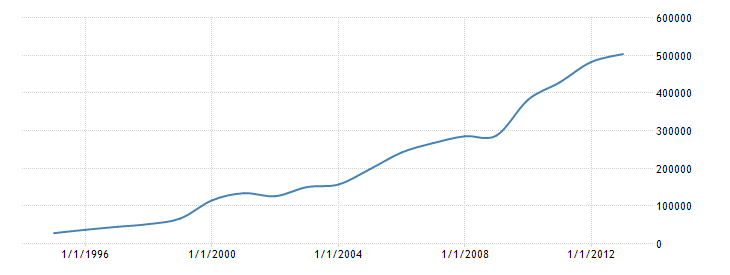
Number of tourists arrivals in The Gambia - 1996/2012, Sources: tradingeconomics

Number of tourists arrivals in Cape Verde - 1996/2012, Sources: tradingeconomics

Moreover, if we want to be among the best, we ought to benchmark ourselves with the best destinations in the business. Small destinations like Cape Verde are doing really well in terms of attracting all-year round visitors. According to the charts above, in the year 2012 alone, the small island has attracted over half a million visitors where as destination Gambia was languishing at around 180,000. Considering the fact that tourism in Cape Verde only really started around the 1970s, and we have been around since 1965, we should look at what those guys are doing right to correct it with what we are doing wrong.

28 Oct 2015

Ethics and Behaviour in the Workplace: A comparison between the private and public sector

Ethics and behaviour of a workforce is a crucial element in determining the success and/or failure of any workplace. According to the hrhero, being ethical involves conducting yourself in accordance with accepted principles of right or wrong, and using integrity ­based decision ­making procedures to guide your decisions and actions. Behaviour on the other hand outlines how an employee should comport him/herself at the workplace. This might include dress code, grooming standard, respectfulness, etc.

Source: The UN
In most developing countries, there is a significant evidence of disparity between the private and the public sector when it comes to the focus on workplace ethics and behaviour. The private sector, dominated by the service industry, understandably lay more emphasis on the matter. In order to ensure customers and shareholders’ satisfaction, the sector understood that it must fully focus on enhancing certain principles and guidelines to safeguard its operation. Employees in the sector in turn must adhere to these principles and guidelines in order to ensure job security.

On the contrary, the public sector doesn't feel that they have any burden of satisfying neither a customer nor a shareholder, not knowing that the general public is their customers and the government their shareholder. Also ignorant of the fact that they are public servants, most public sector workers instead feel that, they are doing the general public a favour whenever they render them any service.

Consequently, the level of unethical behaviour in public sector  industry almost become sort of normality. One can therefore safely conclude that, this is the main reason why the sector is in a dare state and needs to adopt best practices from the private sector in order to ensure the ethical behaviour of its workforce. 

13 Sept 2015

Responsible Tourism: Safeguarding the Image of destination Gambia

The term 'Responsible Tourism' appeared to be a must-use phrase in destination marketing these days. Most tourism marketing campaign use the phrase to try and persuade today's environmentally conscious tourists to their destinations. So what is Responsible Tourism then?
According to EARTH, Responsible Tourism complies with the principles of social and economic justice, and exerts full respect towards the environment and its cultures. It recognises the centrality of the local host community and its right to act as a protagonist in developing a sustainable and responsible tourism. Responsible tourism actuates to foster a positive interaction between the tourism industry, local communities and travellers.
The 2003 Cape Town declaration agreed that responsible tourism:
  • minimises negative economic, environmental, and social impacts;
  • generate greater economic benefits for local people and enhances the well-being of host communities, improves working conditions and access to the industry;
  • involves local people in decisions that affect their lives and life chances;
  • makes positive contributions to the conservation of natural and cultural heritage, to the maintenance of the world's diversity;
  • Provides more enjoyable experiences for tourists through more meaningful connections with local people, and greater understanding of local cultural, social and environmental issues;
  • Provides access for physically challenged people; and
  • is culturally sensitive, engenders respect between tourists and hosts, and builds local pride and confidence.
Sustainability of the Gambia tourism industry is crucial to the country's economy, that's why the government is continuously working on improving the quality standards, broadening the tourism market, and ensuring the rational use of the Tourism Development Area (TDA).  

Unspoilt sandy beaches of Kartong, Kombo South. Photo Source: Accessgambia
Mindful of the negative impacts that comes along with mass tourism such as sex tourism, environmental degradation among others. And conscious of the fact that, the country desperately needs to re-brand its image, the government has set out a policy to combat such negative impacts on the country's image. In summary, the policy identifies objectives to achieve responsible marketing of the destination and to deal with issues of economic, social and environmental responsibility. 

We recognise that in order to achieve this objective, it is in our interest to work together with those who bring tourists and with the industry here in The Gambia. We share the aspirations of the Cape Town Declaration on Responsible Tourism. It is the responsibility of all stakeholders to join with us to create better places for people to live in and for people to visit (Accessgambia).
Talking of sex tourism in particular, The Gambia tourism industry has frankly become a soft spot that has been preyed upon by western paedophiles mainly the very elderly targeting young men and women. Having spent my formative years in the industry, I can attest to this pathetic trend which is sad but true! However, it's worth mentioning that not all Gambian men and women are that cheap to fall victim of such indecent acts. The average Gambian is modest and religious, and is often contented with whatever s/he have.

Unfortunately, the tourism industry like any other industry globally has its own flaws. There are pockets of negative impacts especially to local cultures in any major tourism destination but the benefits of tourism certainly outweigh the negative impacts by a mile.

3 Sept 2015

Enhancing local development towards poverty reduction in The Gambia

At the heart of every human experience is the desire to survive and prosper. To live without fear, hunger or suffering, to imagine how your life could be better and then have the means yourself to change it. Yet everyday, 1.2 billion people - one fifth of the world's inhabitants cannot fulfil their most basic needs, let alone attain their dreams or desires (IFAD).

With one of  the smallest population in mainland Africa, The Gambia has sparse natural resource deposits and a limited agricultural base, and relies in part on remittances from workers overseas and tourist receipts. According to the information site theodora, about three-quarters of the country's population depends on the agricultural sector for its livelihood with the sector providing for about one-fifth of GDP. 

The agricultural sector in the Gambia has a lot of untapped potential. Less than half of arable land is cultivated with farmers relying mostly on rain-fed agricultural activities. Investment in the sector is therefore a necessity as it has great potential to reduce poverty, generate investment and improve food security.
Banjul Shores, Photo Credit: gambiamonitor

A UNDP report argued that, economic growth will not reduce poverty, improve equality and produce jobs unless it is inclusive. However, the report also stressed that, globally, the number of extreme poor has dropped by 650 million in the last three decades, a level of progress humankind had never seen. But still there are more than a billion people living in extreme poverty.

The rural poverty portal of IFAD records that over 60 per cent of all Gambians are classified as poor depending on agriculture for their livelihood. At least half of the country's poor population is composed of farmers and agricultural workers. Groundnut farmers in upland areas are among the poorest. In the North Bank, Upper River and Lower River regions, about two thirds of the population is poor though pockets of poverty can be found throughout the country.

Women Fetching Water for crops irrigation. Photo Source: The Guardian
Understandably, the agricultural sector, if managed properly could significantly reduced poverty in The Gambia. But as already mentioned, no economic sector can register significant progress without the all-inclusiveness of parties concerned. The reality according to IFAD is that, many poor rural households do not generate sufficient income from their farming activities to feed themselves, maintain a decent standard of living and progress from subsistence to more productive and sustainable farming systems.

The following world bank all-inclusiveness guidelines could help booster efforts towards poverty reduction in The Gambia:
  • Assessing the current status of participation, including the representativeness and accountability of governance structures. 
  • Disseminating information on poverty diagnostics, policy options, and goals to facilitate participation. 
  • Seeking involvement in strategy design at the national and local levels and consulting civil society and the private sector. 
  • Analyzing feedback on program implementation and budget execution.
Moreover, there should be even distribution of assets and access to credit facilities to farmers to diversify farming activities. The availability of productive assets (land, machinery etc), quality and affordable seeds, and the support to market farm produce at a reasonable price could tempt more people into taking up farming and potentially reduce poverty.

24 Aug 2015

Tourism Development: Does The Gambia really need new five star hotels?

Many years ago, we were taught in college that; Tourism is the sum total of phenomena arising from the travel and stay of non-residents to a particular destination, in so far as their activities do not lead to permanent residency and are not connected to any earning activities. Based on the above definition, it's then clear that tourism constitutes more than just a place to stay. There are other activities, infrastructures and superstructures that can attract visitors to a particular destination.

upon hearing a statement from the Qatari ambassador to The Gambia that the two countries have agreed to build two five star hotels in the Gambia makes me ponder, is this what the struggling Gambia Tourism Industry really needs. And prior to this statement, an MoU between the Gambia government and Katara Hospitality was signed in 2012 to build a 200 bedroom property due for completion in 2016. The Access Gambia website has a directory of more than 150 accommodation service providers in the form of hotels, lodges and guest houses many of which struggle to fill up even during high season.

An MoU between the Gambia Government and Katara Hospitality

Tourism in the Gambia is mainly seasonal operating between the months of October and April with January to April considered as peak season. Almost 90% of accommodation providers are forced to shut down during off-season and those who manage to continue their operation will have to lay off most of their employees. This is therefore a clear manifestation that what the industry need right now is a clear and robust marketing strategy to attract visitors all year round, and not additional ghost structures that will remain close for the best part of six months in a year.

Surely, there are a lots of areas that needs investment which can complement tourism growth and development in The Gambia. Coming back to the issue of 'travel and stay' which are the two main component of tourism if you like. As far as the industry is concern, travelling from one's destination to a host destination is one thing, but travelling within the host destination itself is another thing. And this is where Gambia tourism still faces enormous challenges. Transportation is a vital infrastructure for any development program, not least tourism development.

Political Map of The Gambia. Source: ezilon
Therefore, I challenge the Qatari government and other international investors to try and venture into the transport industry in The Gambia thereby building a solid foundation for any future development program. Call me a dreamer but how about investing in a rail network? This is surely what Gambia Tourism and The Gambia in general needs. A train line from Kartong to Koina via Basse and From Koina to Barra via Jangjangburreh, will do development in all sectors of the Gambian economy a world of Good.

A Historic Day for The Gambia: World Court Rules in Rohingya Genocide Case

     Peace Palace, The Hague. Photo credit: Wikimedia   On Thursday 19 November 2026, the International Court of Justice (ICJ) in The Hague ...